3.11.18

Outboard engines – Facts, Trends and Brands


Facts
The outboard engine is a very common mean of small boat propulsion system. It consist of the engine itself, the power transmission (gearbox), the propeller, the mounting system, and on smaller units, the incorporated fuel tank. The main function is of course boat propulsion, but it is used also for steering, since it can rotate on the mountings. It is installed on the transom of the boat.
It offers several advantages over the traditional inboard engine:
- it is easier to install

- the engine, gearbox and propeller are well matched (they have to be matched to the hull too)

- it can be tilted, which allows usage it in shallow waters and to reduce the effects of fouling
It is used mostly for smaller, recreation boats, but lately some brands produce units in power ranges that can fulfill the needs of bigger crafts.


Trends
From the beginning, they were mostly small units, with one cylinder, few horse powers and an included fuel tank. Soon, bigger units appeared, with more cylinders, separate fuel tank, remote controls, electric current generator and greater power.
They were regularly 2-stroke engines, because of the simplicity, reliability, lightness and higher specific power of the 2-stroke engines. On the downside, these engines had higher specific fuel and oil consumption, and higher emissions, especially unburned hydrocarbons, compared to 4-stroke engines. But fuel price and emissions were not a problem at the time at the beginning of the 20th century. In the late sixties, Honda started to build 4-stroke outboard engines. Later, in the nineties, increasingly stringent exhaust emission limits, especially in the US and Europe, forced all the producers to the 4 – stroke cycle technology. These engines have lower emission levels, fuel consumption, and smoother operation. However they are heavier and more complex then the 2-stroke alternatives.
In the first years of the 2000s, Evinrude came with the E-TEC direct fuel injection system applied to their range of outboard engines. They gained the favor of the public and some media, since they claim to achieve the best of the 2 worlds: 2 and 4 stroke technology.

Brands
The outboard engine has been around now for more than a century. The first commercially available gasoline fueled (there were some electric before) unit seem to be the 1906 - Waterman Porto.


But there were many interesting outboard engines. Some information about hystorical brands can be found on the Internet site: http://www.cailleoutboards.com/rowboat/index.html


Seagull
A legendary design and brand is the British Seagull, produced in England from 1931 to the mid 1990-ies. It' simple design allowed a great reliability and the engines gained many fans. Many of them still run and are actually used. Details about the engines and their history can be found on several Internet sites. At the end of the century it ended its production because of the ever more restricted emission laws, which the 7 decades technology could not fulfill.

http://www.saving-old-seagulls.co.uk/index.html

Tomos
In my region, the former Jugoslavia, Tomos was the most famous, and often only brand. It was founded in 1954 in Sežana, Slovenia. The factory was soon transferred to Koper, where it started a licensed production of small motorcycles. The outboard production started in 1959 when the Lamo 05k model was released. It was a one cylinder, 50 ccm, air cooled engine that could deliver 3 hp, with the fuel consumption of 0.9 l per hour.


Later during the sixties more advanced models were developed, with water cooling, enhanced reliability and power. They had the displacement of 59.4 ccm and power between 3 and 4 hp. At the beginning of the seventies, the two cylinder models were developed: the Tomos 10 and 18 had the displacement of 250 ccm, and they delivered 7,3 kW at 4000 - 4600 rpm and 13 kW at 5200 - 6000 rpm.


The production ended with the separation of Jugoslavia at the beginning of the nineties.
Detailed information on Tomos history can be found on:

Japan is the country with the biggerst number of outboard brands.
Honda has been manufacturing four-stroke outboard engines for over 50 years, which makes them leaders in low emissions. They produce engines divided in 3 ranges: Portables (from 2.3 to 20 hp), Mid range (25 to 100 hp) and High power (115 to 250 hp).


Suzuki Produces 4-stroke outboard engines in 4 ranges: Portables (2.5 to 30 hp, carburated or EFI – Electronic Fuel Injection), Mid size (40 – 60 hp), In-line 4 (70 – 200 hp) and V6 (225 -350 hp).


Yamaha produces many ranges of 4-stroke outboard engines that really cover all the needs.
- 2.5, 4, 6 hp, single cylinder, carbureted, portable
- 8 – 25 hp , 2- cylinder, lightweight, electronic fuel injection
- 30, 40 hp, 3-cylinder, 750 ccm
- 50, 60, 70 hp, 4-cylinder, 1000 ccm
- 75, 90, 115 hp, - 4-cylinder, 1.8 l displacement
- 150, 175, 200 hp, 2.8 l displacement
- 200 hp, V6, 3.3 l
- 225, 250, 300 hp – V6, 4.2l
- 350 hp, V8, 5.3l
-XTO Offshore - 425 hp, V8 5.6l
Besides, they offer the high tech and performance V Max SHO (Super High Output) line, and claim leading torque, speed, and efficiency:
In-line 4: 90, 115, 150 and 175 hp
V6: 200, 225, 250 hp


https://yamahaoutboards.com/en-us/


Tohatsu began manufacturing outboard engines in 1956 and is Japan’s oldest outboard manufacturer. Outboards were originally developed for commercial Japanese fisherman.
Today they divide their program in 3 ranges. Beside the prevailing 4-stroke units, they offer 2-stroke engines and also LPG powered 4-stroke. Some models have direct fuel injection (TLDI models). There are also some models called Ever Run, which are claimed to have superior reliability.
Portables: 20 hp, 18 hp, 15 hp, 9.9 hp, 9.8 hp, 8 hp, 6 hp, 5 hp, 4 hp, 3.5 hp and 2 (2.5) hp
Mid-Range: 100 hp, 90 hp, 75 hp, 60 hp, 50 hp, 40 hp, 30 hp and 25 hp
High Power: 250 hp, 225 hp, 200 hp, 150 hp, 140 hp and 115 hp.
https://www.tohatsu.com/int/

Mercury
The main American brand is Mercury, located in Fond du Lac, Wisconsin. The first Mercury outboard was manufactured in 1939.
Verado: 250 and 300 hp (V8, 4.6 l displacement), 350 and 400 hp (Inline 6, 2.6 l displacement, supercharged), direct fuel injection
Sea Pro: adressed to the professionals who demand higher reliability, models from 15 to 300 hp, from single cylinder to V8 models.
Four Stroke: dedicated mostly for recreational users, 2.5 to 300 hp models, from 1 cylinder to V8 models, the smallest are carburated, while the biggerr have the EFI (Electronic Fuel Injection) system
ProXS: the high performance line. It replaces the OptiMax line of two stroke direct fuel injection engines. It offers more power per weight, higher speed and acceleration then compared to the Four Stroke series. The technology used is derived from racing models and they rely on higher rpm. The power ranges from 115 to 300 hp.

https://www.mercurymarine.com/en-gb/europe/


Evinrude
An outboard named Evinrude after its constructor exist since the 1909. However, the brand name was owned by various owners. In a period it was Johnson, another American outboard brand. In the year 2000 the company was pushed into bankrupcy. In 2001 it was aquired by the Bombardier group. The Evinrude main site is located in Sturtevant, Wisconsin.
Their bigger models ( not tehe Portables) are characterized by two-stroke technology and direct fuel injection. They claim that it allows them superior torque, pawer to weight ratio, lower consumption and emissions than the competitors.
Portables: 3.5 – 15 hp
E-tec: 25 – 135 hp
E-tec G2: 150 – 300 hp

There are some other very interesting niches in outboard market, like the diesel fuelled OXE and Yanmar/Neander 50hp Dtorque 111, the electric powered Torquedo, the LPG powered Lehr. There are also some competitive Chinese alternatives to the mentioned mainstream production, especially in the lower end production. We could mention here the luxuary niche promoted by the American 7-Marine. However, theese occupy smaller market niches. I could possibly write about them in a future post.


23.10.18

Cruise around Krk to Rab, 22. -28.7.2013.

This is a story of a beautifull adventure that happend at the beginning of summer of the 2013. It showed that my small trailer/sailer is capable of real cruising. The story is published also on the Manta 19 site:
http://www.manta19.miwd.co.uk/blog/index.php?view=161#


We planed a trip for the same summer with the same good old crew from an earlier cruise on a rented, bigger sailboat in Kornati, comprising: my sister Ana, her friend Anna and her husband Jordy from Barcelona. Since Tweety was docked on the island of Krk it seemed natural to plan a circumnavigation of it. In addition, we wanted to reach Rab (on the homonymous island) and be able to take part at the Fiera, held every year from 25 till 27 July. It is a historical reenactment and festival on the island of Rab in Croatia, during which the residents of its main town try to present the life of their ancestors in three days of costumed performances and demonstrations of traditional arts and crafts and local produce.


The boat

This is Tweety (named after the Yellow bird from the cartoon), a Manta 19 built in Austria in 1978. I bought it in the spring of 2013, to become its third owner in almost 40 years of its existence, but this sleek boat is still in great shape. I still keep it moored in the bay of Soline.


After buying it at the end of winter in 2013, I had to do some little maintenance work and fulfill a tremendous amount of bureaucracy and documentation, as well as taxes´ requirements. I wanted to describe that as well, in a separate document, since it was grotesque to say the least, but after all the hurdle was done and over I forgot about it, probably repressing it, as it had cost me a lot of nerves and frustration.


22.7. - Packing, departure, sailing under the bridge, Omišalj, Njivice (1-3 on the map)


And so we did. We met in the morning on 22nd July. The packing (water, food, new chemical toilet, clothes...) lasted long, so when we finally left the mooring it was very hot. We motored to the entrance of the Soline bay and then opened the sails there. We tried to catch a little wind, only to realize that sailing in the north Adriatic in July requires a lot of patience. As soon as we opened the sails the wind would die. We had nothing left to do but to proceed by alternating sailing and motoring to Jadranovo to the east. Then we sailed under the Krk bridge. We passed over it thousands of times by car, but this was our first time under it so we considered that to be a major milestone. That was so exciting! After a few hours of sail-motoring we turn the north cape of the island and it was time for a break, a refreshing swim and a late lunch. We ate sardines from a can under the new sun shelter tent.


The tiny bay is not very protected but in summer time it is usually full of boats. The locals have even built some wooden and concrete quays to make it easier to reach their boats (avoiding entering the sea). We found an empty docking place on one. We hoped that nobody was going to send us away from there and in the meantime we could step from our boat ashore staying dry. We walked to Njivice to have a coffee and use the toilets. After sunset we came back to the boat and prepared dinner on the gas stove, pasta with tomato sauce. Delicious, accompanied with red wine.


After dinner we went to sleep. The Manta was almost overcrowded with the four of us, but we were very satisfied of our first day and pleasantly tired, so we slept well like babies.


23.7. Malinska, Šotovento, Čavlena, Glavotok, Krk, Punat (3-5 on the map)

We got up, swam, had breakfast. There was absolutely no wind, so we motored in front of Malinska bay where we had been swimming every summer during our childhood. We sailed by Porat and got to the “Šotovento part” of Krk. We stopped in Čavlena bay for another swim, lunch and a break. There are few boats but no real crowd at all. We proceeded in front of Glavotok with its church and monastery, surrounded with beautiful woods. We tried to sail in the afternoon but we had to go against the wind, so we advanced rather slowly. After a while we started the engine again. It worked without any problems. We checked the amount of fuel left. We decided it was not critical, but it would be wise to buy some. We knew there was a boat petrol station in the major cities: Krk, Lopar and Rab. When we came in front of the city of Krk it was pretty late. We decided that it would be a problem to find a nice place in the port, so we continued to a bay after Punat, in the hope to find a mooring spot in the wild. There is a nudist camping resort. We walked to its café´, dressed. Some people were dressed, most were not. After a nice relaxed beer drinking session, we returned to the boat and had dinner on the beach before going to sleep.


24.7. Sveti Grgur, Lopar (5-7 on the map)


After the usual morning routine, of swimming in the clear blue sea and breakfast, we continued along the coast of the island Krk. Here is pretty naked and wild. The sea was absolutely flat and there was no wind at all. We gradually left the coast and pointed to the south, to the small island of Sveti Grgur. It is famous because it used to be a female prison during the communist regime in Jugoslavia. It is a very emotional experience to reach an island for the first time with a small sailboat and we all enjoyed in that feeling of excitement and adventure. 
We entered into the bay and found a well protected small port, with several tiny boats moored on the quay. The sea was shallow at this point, so bigger boats could have not reached shore, but our Manta 19 with its lifting keel had no problems. We threw the anchor from stern and tied the bow to the quay. The other boats seemed to had stayed there for more days and the sailing crews to know each other. This island is not inhabited, but in summer there are visiting tours from the neighboring islands. Few hundred meters from the port, there are young deer, behind a fence surrounding a park and several demolished buildings of what appeared to be the rests of the infamous architectural complex. On a sign it is written that it is property of a hunter´s association. Our imagination brought us images of woman imprisoned because of different – anti-communist- regime - political opinions. The same buildings are nowadays populated only by big spiders. We found nets are all over our heads. We followed a narrow path which lead us to the next bay. It was more crowded since there was a restaurant, with tourists who arrived on 1-day –tours from the islands of Krk and Rab. We enjoyed a standard meal of fish and chips, nothing special. It would be nice to come back on the island, I really liked it, but then we could not stay longer, as we had to proceed in order to reach our destination on time for the big opening of the Fiera. 
So after a rest we continued to the south-east in the direction of Lopar. We were short of fuel so we had to find a bigger harbour with a petrol station. We reached the island of Rab and entered the wide, but shallow Lopar bay in the afternoon. It is a bigger nautical centre, so it is full of boats. A ferry arrives here too. We found a place on the top of a quay and tied the boat sideways. We asked some local fisherman for approval, and they said it was ok. We went shopping in the supermarket, we bought food and water. And we refilled our canisters with gasoline. On our return we prepared and enjoyed a nice meal on the quay.
Later we went to sleep. But I could not fall asleep. I heard boats passing. The waves started to enter the bay from the west, and I continued to think how unprotected we were. The boat swung on each wave, it rubbed the fenders, and it squeaked. The swinging keel produced its unsettling noises too. I saw lighting. Far from us, to the west, but I could not stop worrying. I was happy when I saw the morning sunlight, even if I knew that the day ahead would have been a difficult one as I´d be tired.


25.7. Kalifront, Rab (8-9 on map)
We continued in the morning. We passed in front of the big and shallow bays of Supetarska Draga and Kampor. As we reached the Kalifront peninsula the traffic got thicker. Many powerboats and yachts passed along us, and disturbed us with their wakes. Kalifront is covered with a beautiful protected forest. There is also a site of the Faculty of forestry, and many hiking paths. There are also many beautiful bays. We chose one for lunch, a swim and a rest. I managed to take a nap. My sister got stung by a wasp, but we happily discovered that she is not allergic. Then we approached the city of Rab. The traffic was terrible at the entrance but we were so happy at the sight of our final destination with its marvelous city walls and four bell towers. In the bay, among hundreds of local and tourist boats there were a big cruiser and a beautiful 4 mast cruising sailboat. We found ourselves a mooring on one of the wooden quays supported by iron poles. There were many boats and people swimming around it. We asked if we could stay there, and a local man showed us a place where we could put our boat. Perfect, a free mooring in a place close to Rab! In the neighborhood there was a beach with showers that we were allowed to use, a restaurant (with real toilets!), shops, and everything we needed. We swam, refreshed ourselves with drinks and showers and rested for a while, and got ready for the Fiera. Its inauguration was scheduled for that very evening. 


We walked to the center through the crowd. There were many stands with food, beverages, traditional items, artists, buskers...the locals were dressed in traditional costumes. The opening was marked by a cannon firing. The party in the streets and many bars was going to last till morning. We walked and had fun, but after a couple of hours we felt all the tiredness after such an eventful day so we went back to the boat to sleep.

26.7. Rab-Cape in front of Lopar (9-10 on map)

The next day we were rested so we went back once again to the city to do more sightseeing , this time with daylight and less crowd. We walked through the center, the three parallel streets, we climbed the bell tower, we ate fish in a restaurant. It really is a beautiful town, and it would have deserved more of our time, but our holiday was short, our boat was relatively slow, so after having a planning session with all the crew, we calculated the time we would need to complete our journey, and sailed off to the open sea in the afternoon. We bought more fuel before, just in case, to be on the safe side. We had to return home, by circumnavigating the island of Krk, thus reaching the Soline bay from the other side. 


Most of the afternoon we motored around Kalifront. We greeted with waving and smiles possibly every small boat similar to ours. We were pointing directly to Krk, in the hope to be able to reach it fairly quickly, but after we realized it was too far away, we decided to stay overnight on the cape in front of Lopar. It was not a very protected spot, but the weather forecast was predicting very stable conditions. We passed by a small church on the shore - it looked very romantic in the red sunset light. We found a nice beach in a small bay and threw the anchor from the bow. We swam and took the ingredients for the dinner ashore. While I walked on the beach with my feet in water, I almost stepped on an octopus. It escaped. I tried to follow it, but I did not manage. It shot its black ink and disappeared. Pity, it would have made an even better dinner! We prepared our meal and drank some wine. When we went back to the boat it was pitch dark, but we were not afraid.

27.7. Baška – Mala Luka (11-12)

We slept well. I felt a bit “kind of melancholic” because I was aware the trip was going to end very soon, sooner than we´d wished. We started before breakfast in order to avoid to be in the middle of the sea when the sun is at its peak, because it can really get unbearably hot. We ate while we sailed. In the morning there was no wind at all, so we had to motor. We made 4.5 KN. We pointed this time to Baška on Krk island so to leave the beautiful island Sveti Grgur on our right. We passed trough the narrow channel between Krk and Prvić, another uninhabited and interesting island. Further on the east we could admire the dramatic island of Goli (which means “naked”- since there are no trees, only rocks and stone), (on) which was the notorious, equally infamous prison for men during the communist regime. It would have been interesting to visit it too. When we turned around the east cape of Krk we saw the beautiful town of Baška with its long beach. We approached it and decided to moor at the big breakwater. There were some boats, but also some free buoys with mooring lines. We found a place for us, but were not sure if we could stay, so we decided to split into two groups. One went sightseeing, and the other two took a place in the shadow in front of a café´ with the view on our boat, so to be able to see if anyone would mind us being anchored there. Later we went to a restaurant to eat fish. We discovered that the waiter is or neighbor´s friend. We stayed in Baška until late afternoon talking, resting and swimming. 


Then we proceeded. We opened the sails but as usual when cruising, we had to ascertain again that the wind was coming from the wrong direction, so we just accepted that we were to advance slowly, again. Sunset caught us just in front of Mala Luka, a bay perfectly sheltered from all the winds. We entered and found several boats and a Robinson Crusoe-style restaurant. 


Since we had had lunch in a restaurant, we decided to have dinner on the boat. We prepared a salad and accompanied it with wine under the stars. We were very happy but the melancholy from the morning came back, and we shared our thoughts: tomorrow we were to sail back home. We took advantage of the beautiful warm night for one of the last swims and the final group pictures.


28.7. Mala Luka-Cape Glavina – Soline (12-13-1)

We started early, and had breakfast on the fly again. The coast from Baška till cape Glavina is naked, without trees, because of the “bura”, a cold and very strong wind that blows here from NE. When it blows, better not be here. Fortunately, it was quiet. The coast was naked and dramatic, with high, vertical cliffs.
 

In fact, there was no shelter till cape Glavina, which we reached around noon. Around, there were several nice bays and we chose one just after the cape. We prepared the meal and swam. In the afternoon we pointed to the cape in front of Šilo, leaving the beautiful Vrbnik far on our left. When we got further from the coast, we noticed a pretty strong wind. It came from stern, so we could catch it. Finally there was some good wind also from the right direction, from NE. It was the dangerous bura, but this time its intensity was right, we got just as much as we needed. We got on with a speed constantly over 4 KN, with peaks to 5. We arrived in the early afternoon, before schedule. We were very tired but happy. It had been a great unforgettable adventure.


14.10.18

Manta 19


Manta 19 was created by the Austrian designer Anton Miglich as a small cruiser/racer in the 1970's. David Hutchinson of Blakes Marine was showing their Kelpie yacht at the Friedrickshaven boat show in the early/mid 1970's when he first saw the Manta 19. He arranged to have a series of test sails on the local lakes near to the Austrian builders (Schoechl Yachts) home base and he was so impressed that he negotiated permission to build 200 Manta 19s in the UK under license.

The boat was advertised as a family cruiser, but for today standards is small to take the whole family on a cruise. However, it has 4 berths. It has relatively good performance, so some call it a cruiser/racer. The best definition, by today standards would be classic trailer-sailer.
It was very well built. Double skin construction was used for internal elements, which gave a nice finish, good insulation and eliminates condensation problems. In evidence of building quality, a great number of over thirty years old boats is still sailing all around the world. The lifting fin plate in the cast iron keel is a great compromise for sailing performance, practicality of use and maintenance, shallow waters capabilities. It allows easy retrieving, trailering and hence savings on mooring fees.
The maintenance is reduced to varnishing the wooden elements (companionway and tiller) and renewing the antifouling every year and occasional smaller repairs.
Although some say that a fiberglass boat is no real classic, whit such great lines, the Manta deserves such a title.
Since it has many happy owners all over the world, there is also a dedicated web page: http://www.manta19.miwd.co.uk

Data
LOA excluding rudder 5.66 m
LWL 5.03 m
Beam At Deck 2.07 m
Beam At Water Line 1.72 m
Draft Keel Only 0.485 m
Draft Keel and Plate 0.915 m
Displacement 680 Kg
Ballast 185 Kg

Sail Areas
Main Sail 5.48 sq.m
Working Jib 5.34 sq.m
No1 Genoa 7.4 sq.m
No2 Genoa 9.0 sq.m
Spinnaker 17.0 sq.m

General Info
Bunk Lengths 1.90 m
Cabin Interior Height 1.26 m
Foam Buoyancy 0.52 cu.m


Tweety

I bought a Manta 19 in spring of 2013. This particular Manta was built in the year 1978., the same as the current owner – myself. I found it in an advertisement and fell in love with her lines. After few months I had the opportunity to visit it, in another city, and I saw that it was in great shape.
Before me it had 2 owners: a pilot, who kept a systematic logbook, and a naval architect. No wonder if it is kept so well, I hope I am doing a good job too at preserving it.
The transport was arranged for few days later by truck. After the paperwork (complicated at the time), she was ready for the sea. In July of the same year we went for a 7 day cruise, 4 adults. I named it Tweety, like the little bird from the cartoon.
It is pretty multipurpose. I use it to host some friends for sailing and swimming during the summer. I use it for solo sailing, fishing, daily excursions, cruises of the duration of few days. At the end of the summer I lift it and keep it in the garden. I write down some lines of text to a logbook to remember this nice moments: who came, when, what we did, what we liked..
Of course, sometimes I wish a meter (or feet) more of comfort, or a knot more in speed, but it is like that for any boat owner.

Short video about Tweety
https://www.youtube.com/watch?v=rIpCiSyRTFY


8.10.18

S 400


This is the description of the boat that has not (yet) been built, but intrigues my mind a lot lately. It is partially the reason to write this blog. At this point of my life I can't find the time or place to build it and to use it. So, this blog can make it a little bit more alive. Its a small and simple sailing dinghy like many other, but it should fulfill many requirements:
- relatively easy to build: classic stitch and glue, flat bottom towards the stern, two chines per side, simple deck and equipment
- beautiful to look: elegant and simple, plywood left varnished on some critical spots, a good compromise between fancy wood look and easy maintenance
- lightweight: the composite plywood construction is lightweight per se. I would use 5 or 6 mm thick plywood. I suppose I could build it to weight about 50 kg. This is very important for performance, but also for practical manipulation ashore, without too much help from other helpers.
- easy to move on the shore: I had bigger boats. Everyone would be glad to help you to pull it to the trailer or turn it over for maintenance for the first time. Every next time the enthusiasm about the help with your passion will decrease. So it is important to be able to do the manipulations on your own.
- allow oar and outboard propulsion: sometimes the wind dies, and you have to get ashore in time. Or it can be used to reach faster a distant, desert beach with some passengers. Or to reach a distant fishing spot when there is no wind.
- can be sailed alone, but also take a passenger or two. Often I do not find the company for my sailing excursions. But it is a great joy to share the passion of sailing with some crew or passengers
- can be used for fishing: smaller, sportier dinghies do not have enough space to carry fishing gear. And the fish:-)
Somehow it is a compromise between the smaller and the bigger boats I owned, each with its limitations. Hopefully, this one would overcome this limitations and replace both.
The boat is just under 4 m long and 1.56 cm wide. I have the basic drawings, from which I would be able to build it. If many people would express interest, I could develop a more detailed set of drawings.
Here are some drawings and presentations:


2.10.18

S 500 - Mića


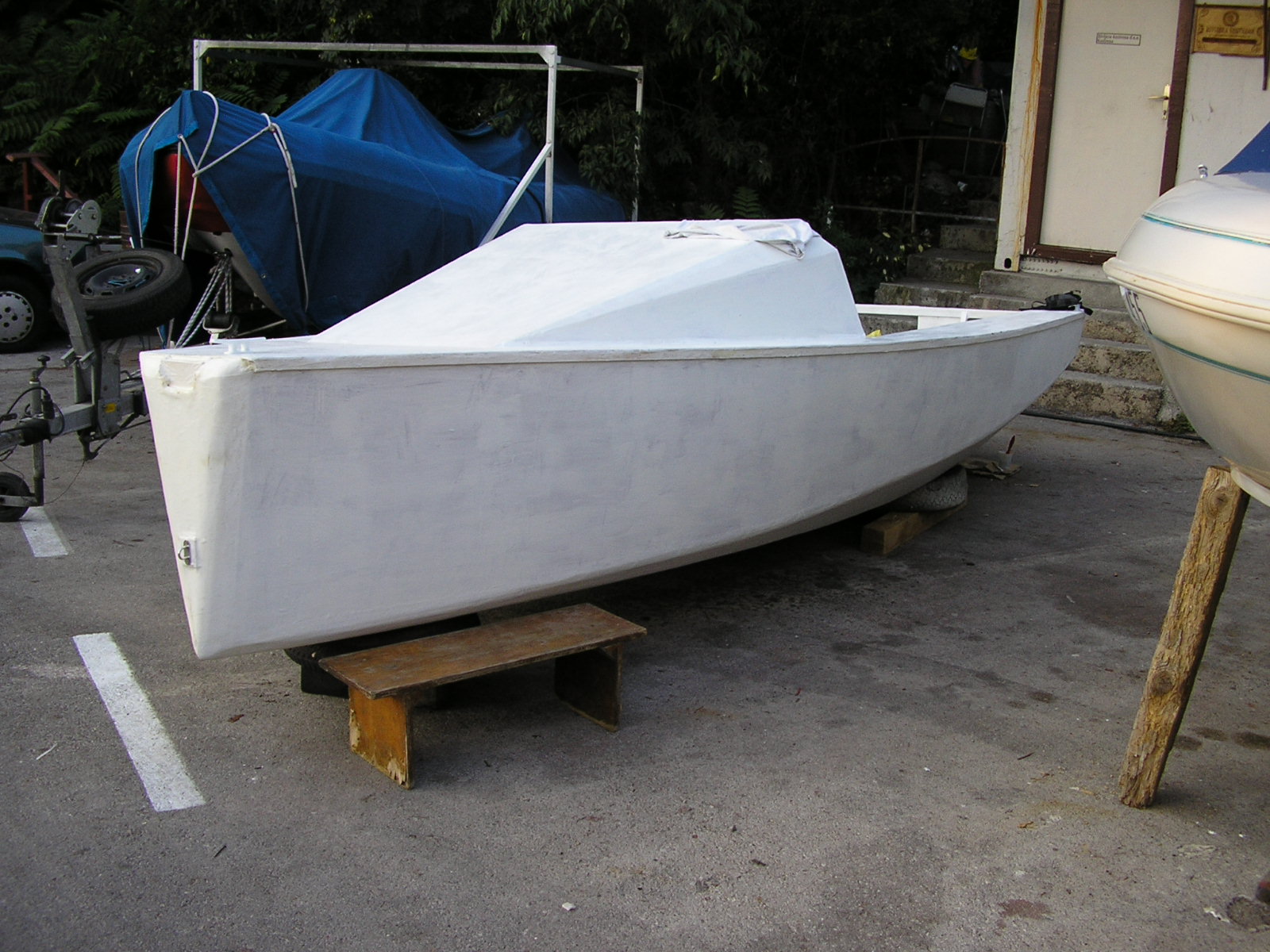
This is the story of the first sailboat I built. It was in the 2004 when I was a mechanical engineering student. At the time, small sporty boats were in my dreams, like the Open 5.70 by Jean Marie Finot or the Speedfeet 18 by Marc Lombard. This wonderful little sportboats were, of course, out of my reach with their price of about 20000 Euro. But I could not stop dreaming and I was searching the boatbuilding forums and blogs. Then I found the pages of Cantierino, the italian DIY boatbuilding site with lots of amateur builder experiences. I found the software Carene, with which it's easy to design a simple plywood hull for the stitch and glue method. I found Spray store – an online shop which had Epoxy resin, glass fibers, and other boatbuilding materials.
The building site is always a problem. I could not find an empty, dry and warm place to build my boat. I had a friend who lived with his parents and they had a big, empty ground floor. I talked to him, and they allowed me to use it for few months. I prepared some drawings with Autocad. Before the start I talked to a friend who was a naval architecture student and to his father who was an experienced boatbuilder and sailor. They did some calculations, gave me few suggestions and said that the plans were OK.
I ordered the materials and bought some plywood by the local store and the building adventure could start. I bought 9 peaces of 8 mm thick okume (marine grade) plywood of the dimensions of 2,5 x 1,7 m. I transported them on the roof of my Renault 4 to my “shipyard”.
First I transferred the lines from the plans to the plywood. Then I cut the parts with the jigsaw. I glued the long hull parts with an overlapping joint. I glued wooden strips along the borders of the bulkheads. I built a simple V-stand to support the bottom. I stitched the sides of the bottom and glued them together. After it, I proceeded with the vertical elements. The internal volumes are covered with resin and protected with paint before closing them. The outside was completely laminated with resin impregnated glass fabric. In the end the hull was painted for aesthetic and protective reasons.
I cant find the original drawings any more, but the dimensions were 4.85 m length with a width of 2.16 m. I named it Mića, which means "little" in the local dialect. I turned it over with the help of some friends. A text about it can be found on the Cantierino pages here: http://www.cantierino.it/Aesperienze/Mica/Micia.html. For the hull it took me about 250 hours. Afterward, I bought a used mast of a 470 dinghy and an old set of sails. I bought also an old trailer and a used Mercury 3.3 outboard engine. It took me some more time to build the centerboard, the rudder and to put all together.
Overall it was an extraordinary experience which I would repeat. And I did. I will describe also the other building experiences in some next posts.
The sequence of building is presented in the following pictures.