18.2.19

Sailboat cruise in Dalmatia, part 5


The next day we continue to wander among the islets. We leave early because we expect a longer leg. Later the mistral wind rises and we sail with the wind in the stern. When the lunch time arrives, we look for a suitable place for anchoring. We decide for a bay on the west side of the islet Ravni Žakan.


 Among a few sailboats there, one is particularly elegant. It must have 20 meters. We dream a little to navigate with something like this. We catch a buoy in front of a restaurant. The staff from the restaurant comes to us. We tell them we'll just dine on board and go on so we are not charged for the mooring. On the other side of the island we notice several masts of sailboats as there is another restaurant. At this time of year, for who can afford it, you can really eat well here in one of the many restaurants and taverns (konoba). We go on as the wind is rising. We pass between the Kornati and the Mala Smokvica island.


 Now we are heading to the north with strong head wind towards the island Žut. We tighten our sails, we tilt... we follow the speedometer ... on several occasions we achieve our own speed record. Racers might be laughing about our speed, but to us, modest tourists, that is a sufficient reason for joy and excitement.


At one point, Jordi suddenly turns from the course. He noticed that the number on the depth gauge fell drastically. Depth is quickly normalized, we look at the map, we consult a book, we check the cell phone map ... nothing, there is no sign of a shallow region. Could it be our instrument error? We continue to move to head. We notice a strange noise from the cabin. It's coming from downstairs. Are there some vibrations caused by the flow of water? After a few unpleasant moments we find the source: as the boat tilts with an almost empty water tank, the water pump draws air. We turn off the pump and relax a little, well that's nothing serious. The wind decreases, but we do not regret it because we are a bit tired of the sun and the excitement. We are looking in the map where we could spend the next night. We choose the spacious Hiljača bay, which should be protected from almost all winds according to our the navigation book and offer a safe anchoring base. Although it's early, the bay is quite crowded. We throw anchor at a safe distance from other vessels. We're checking the anchor. Not very well, the bottom is rocky on this part, mostly smooth except that there and there is some big stone, which is perfect for holding anchors. We observe the anchors of other vessels. If there's something going to blow tonight there will be panic, the anchors just lie on a flat stone surface. Fortunately, the forecast for the night says no wind. But we are lazy to search a better bay. We do not feel smarter then all other skippers. After bathing, as the dark falls, we prepare dinner. As every night we talk about the day, we plan a for tomorrow, we joke, we have fun, we look at the stars ...Then we hear some kind of sound from the cabin ... like a kind of easy ticketing ... Was not there enough excitement for today? We're lifting the floorboard, we check the piping on the engine, looking under the pillow, everywhere! Everything looks okay but we hear it! Is this some kind of osmosis, thermal dilation or what? We throw different theories, but we're not having fun at all. We drop the dinghy to look at the outside of the hull. At the bottom of the inflatable the same ticketing. Under the light of the flashlight in the sea there is life: plankton, insects, fireworks and similar.. I take the can and grab the water under the light. I have it! I caught the "monster"! I throw it on the deck and it seems we've discovered the sound source. Some kind of worm swims around the cane at a high speed and hits the walls. In the sea there are surely thousands of them. Now that the mystery is solved, fear leaves the place to laughter. We laugh at various theories, and we conclude that the ship will not melt overnight, and probably the worms will not eat it either!

10.2.19

Sailboat cruise in Dalmatia, part 4


After lunch we head towards the Kornati archipelago. The impressive lighthouse welcomes us from the isle of Vela Sestrica and we leave the civilization we know behind our stern. If there was a crowd in Telašćica, here are just a couple of sailing boats on the horizon.


During our easy navigation to the south, we observe the interesting forms of islets. We are looking at the map and discuss which one is which. It's hard to say if they're more interesting on the map, with their bird-eye shapes, or in place. Some show a layered structure, some resembling monsters and some remind facial expressions. They are mostly naked, without vegetation with rocks as cut to the southern side.

It reigns a relaxed peace that is only from time to time interrupted by a yacht or tourist boat. At the end of the day, we choose the place to spend the night. We select the Vrulje bay. There are already plenty of boats there, but we gained some experience so we are not intimidated.. So we drop anchor in front of the National park administration building. We are told that there's no problem and we can stay there. We are looking at other ships around us: several sailboats, a few motorboats, a fleet of charter sailboats that are massively tied to one buoy and between them. This does not seem a school example of a safe mooring, but weather is calm so it should not be a problem. The most interesting is a small green steel sailboat, quite narrow and square, probably a do-it-your-self construction. The French flag and wind generator create a picture of a world traveler who must have seen many seas. It is considered that France is the cradle of ocean adventurers, single handed sailors. Skipper's style is in line with the boat: a few months beard. We have not noticed a pipe, but we are sure he has it somewhere aboard.


The place of Vrulje is very interesting, another oasis of civilization surrounded by sea-world. The superscription Market calls us from the roof of one of the houses. There are no big buildings, some are upgraded, but all have roots in traditional, modest, characteristic local buildings from Kornati. The small shore and the few alleys are mostly non concreted. There is a gurgle coming from the terraces of a couple of restaurants that at least at this time of year contribute to the above-average liveliness. We decide to walk and buy some stuff in the Market, more to feel the experience than for real need. Indeed, in the era of various glittering shopping centers and supermarkets, the market in Vrulje is something completely different. In front of the house, a mother and daughter sell local products. We talk to them. They talk us about tourists, about Kornati islands and their history. We climb the hill above Vrulje. Although it is already dusk, we do some beautiful pictures of the landscape. The Archipelago, a picturesque village in the bay below us, a sailboat, the colors of the dusk, which can not be captured in the photograph. With the help of the moonlight and a head lamp, we return to the place by a rocky path.


13.1.19

Sailboat cruise in Dalmatia, part 3


The next morning we proceed towards Sali, on the south of Dugi island, where we plan to renew our food and water reserves. As usually, we do not sail straight to the destination, but fool around a bit. Then suddenly, we noticed a group of dolphins! What an excitement! We were told that it is common to meet them, but we were not expecting them. We try to follow them, but they go their way. We are pleased that they showed us few jumps out of water.
In front of Sali there is a crowd: sailboats, motorboats, a big cruiser ship, visitors are going ashore with small boats. Even if we are already used to our sailboat, entering and mooring into a crowded port is not a routine. The port crewman invites us from the quay and shows us where to go. We approach carefully, throw the ropes, catch the moorings and complete the operation. We are satisfied by our mooring skill. We inform them that we will stay just for few hours, to buy food and have a coffee. We have to pay just for the water, they give us instructions about the village.
Sali would deserve a longer stay. It is very nice, small but full of life, with a strong taste of sea, like a seaman's oasis. Interesting coffee bars, a sailing club, a tourist agency and certainly many other things that we did not discover. We shop in a market, we have an ice cream and charge our phones. And another important thing: we buy the tickets for the Kornati national park.


As we planned, we proceed to the south. Our next station is the large Telaščica bay that used to be part of the Kornati national park, but now is a separate nature park. After a short sail, we carefully pass through the narrow passage between Dugi island and the small island Katin. That is actually the entrance to the national park. Here the sea traffic is pretty dense. Many sailors come tho these waters in this period of the year. We continue to sail across the big bay til sunset. We pass along many nice anchorages and moorings with buoys and beautiful yachts. Finally we catch a buoy relatively close to the restaurant. Even if we heard that the generator of the restaurant makes noise, we decide to stay there, since it' s too dark to go for further buoy hunting. We are surrounded by many boats of all sizes and shapes. There is an inflatable, a RHIB that seam to be double in size then our sailboat. It's a new trend, which I do not like particularly. Early in the morning I sea a ship passing close to us. Its anchor chains noise breaks the morning silence. The crew takes the pipes to the shore. It is a water carrier. To me is a new detail, but islanders are used to it, and it means life to them. I continue to sleep. We get up late and have breakfast. We go ashore by dingy and search for the salt lake and the cliffs. The sun is high in the sky and it's very hot. We ask for direction and realize that we were walking in the wrong direction. I feel a little bit shame. We go back. We sea a crowd of tourists walking by a path. They must be going to the salt lake. The crowd spoils the beauty of nature, but who can we blame, it's our fault that we overslept and took the wrong path. We join the cue, and arrive to the Salt lake. It is interesting. Some people baths in it, but it's not attractive for us since it is too crowded and too warm. We just watch and take some pictures with the cute little donkeys that live there. They seem to be used to the great number of tourists. We walk to the high cliffs on the south-west side of the island. We admire the view and take some pictures. Here is an advice: if you arrive the day before, visit the Salt lake and the cliffs early in the morning, before the tourist boats arrive from mainland.


30.12.18

Sailboat cruise in Dalmatia, part 2 (Pantera bay - Rava island)


We wake up in the morning and repeat the early swim ritual and we make breakfast. Fried eggs with cheese and onion was my specialty.. Nutella, cheese and vegetables, coffee ... sometimes we would prepare the lunch before the departure. We lift the anchor and go. On the exit of the spacious bay, a German nice trimaran overtakes us. The wind is weak, so neither it is very fast. We take same photos, and discuss about its performances, the pros and cons. We sail to the south, a little bit towards Zverinac isle and then back to the Dugi. Then suddenly we spot a hole in the mountain. According to the book it is a German underground submarine refuge. But we think it could also be built by the Yugoslavian army after WW2. We approach carefully. The sailboat that was anchored just in front of it lifts the anchor and leaves. Since it was much bigger then us, we deduce that we can come just till the entrance. We drop the dinghy. Some by rowing, some by swimming, we enter to the sea tunnel. It is impressive, exciting to imagine submarines entering the hole. Lake in a James Bond movie. We swim inside, walk along the paths on the edge, take pictures and perform water jumps.


After a while, we lift the anchor and continue to the south. We sail zig-zag, chasing the wind and island landscapes. We check some beautiful bays. We have lunch while sailing. As the day comes to the ending, we check on the maps and in books where could we pass the night. The island Rava, with its rugged coastline seems perfect. Just before sunset we arrive to the first bay, Mala Rava. There is no too much space, and we are not very experienced, it's crowded to us, we are hesitating...an Italian sailboat pretty fast enters the bay with a buoy hunter on the bow and targets the buoy chosen by us. We hurry up, and show them then they will have to choose another one.
When the adrenaline dies and the impressions of the day calm down we get aware in what kind of paradise we just arrived. A small village with colorful houses, an old grandpa sands the hull of an wooden boat on shore, children playing in ankle deep water, few people talking, a dimmed conversation from a local restaurant...what a nice atmosphere. As every evening, we recount the day during a light dinner. In the morning we walk around the village, talk to some people and go for a coffee in the local restaurant.  


26.12.18

Sailboat cruise in Dalmatia: Ugljan – Kornati


This is a description of a sailboat cruise that took place in the summer of 2008. (20-28th August), with my sister and a couple of friends.
Last summer, when friends were with us while sailing on a small sailboat, there was an idea for the next summer to make a real cruise and spend a week sailing to the Adriatic. That could have been one of a hundred ideas, one of those that usually falls with coffee in the cafe, and it goes off before the end of the winter when various business and social responsibilities arise. But this time that was not the case, it turned out that we were really interested in this idea and we really did take it for realization. Searching the Internet, dreaming about destinations, evaluating prices, contacting a skipper friend .. the adventure started while still the snow was falling out.
We do the paperwork at the reception, and the skipper shows us all the boat's systems and relieves the ambiguities with patience. We add more water reserves. The excitement grows when we decide to let go the moorings. Although the friend Jordi and me are sailors and we have some experiences from various trips and regattas with bigger crew, it is for the first time that we take the full responsibility for such a boat. I hope we have successfully hidden our anxiosity before of the departure. Immediately in front of the marina we find a nice mistral wind. There is no time for waiting, we have to try the sails. We sail to the north-west of Ugljan hitting large waves while the excitement grows. As night arrives, we estimate that we wont turn the cape of Ugljan and we return to a small bay near Sutomiscica. The small boats that we saw there before left, and left us almost a desert bay. We check the depth and drop the anchor. As part of the evening bathing we check the bottom. Weather forecast says it will be a quiet night. The adrenaline because of the departure for the adventure that has floded us for hours gradually disappears and gives way to total relaxation. We are preparing a simple dinner, talking with wine in the cockpit under the stars until late night.

The next morning, the rays of the already high sunshine wakes us up through the portholes. Unspoilt, warm, blue-green sea is waiting just for us. The morning jump from the boat is a liberating spiritual experience. After swimming and breakfast we will continue to sail further to the north. When the mistral appeared, we opened the sails, although it was a really weak. We pass between the island of Sestrunj and Molat towards the Pantera bay on the island Dugi. The spacious, shallow bay recalls a tropical atoll. We catch a buoy in the north-east part of the bay. After bathing we go to the land to visit the lighthouse and the populated place of Veli Rat. We enjoy walking and taking some pictures, but it's really hot. We got quite dehydrated. Luckyly, we find an open store, so we buy a lot of refreshing drinks. As we walked we got hungry, so we decided to have dinner in a pizzeria. While we ate and drank, we were caught by the darkness. And the way to our boat was not very bright. On the asphalt it was not too difficoult, but at the end we stumbled through the woods, tapped the beach looking for our dinghy and deciphered the contours of the sailboats without anchor lights (one of them was ours). However, we have successfully found our Puntica and after all had a good laugh at our little, late night, gourmet excursion.


The sailboat was an old but good Elan 33.
To be continued..


9.12.18

Motorboat M480


I like sailboats a lot. They offer that connection with the nature, the free, silent, ecological source of energy. The infinite range. Then, there is the physics involved: wind speed, lift force, drag, buoyancy, equilibrium, momentum … all fascinating terms. Even Albert Einstain was aware of the beauty of the sailing activity (https://boatingnz.co.nz/articles/the-universe-relativity-sailing/).
But not everyone shares these opinions, someone prefers the speed, power, independence of the weather that motorboats offer. I also have to admit that lately I was in situations then I wished to have a motorboat (guilty), or more precisely to build one. I am free from work mostly in summer, when here, in my waters, winds are weak and irregular. I often embark some friends that do not know how to sail, or do not have the time or patience to wait for the breeze. I use to combine sailing to reach the fishing spot, and fishing. But if it' s just the afternoon, after job, usually I have just few hours, so I have to decide for just one activity.
Considering also the boat conception, small cabin sailboats are really nice, but no boat can fulfill all the needs, or, there have to be some kind of compromise. Sailing gear is somewhat cumbersome: long mast to lift, heavy centerboard to lift, low boom to be hit with, sails in the cabin...on a small boat reduces the space for the crew and for other (fishing) toys. Also, usually sailboat hulls are displacement hulls, so speed is limited to the displacement speed, i.e. about 5 knots for a 5 m long hull. A semi-displacement or planning hull can offer higher speeds, which is also an attractive feature. It allows reaching further in the limited time. It allows to escape bad weather.

After this introduction, I would like to present one of my plans for a motorboat.
M 480 stands for Motorboat, 4.8 m long. My boats are often planed to be 4.8 meters long because this length can be obtained by adding two plywood sheets of the standard dimension of 2.5m in length. The lines are pretty classic, similar to local boats. A 2.4 meters long and 1.6 m wide cockpit is the main living area. The double floor makes it self-bailing. The cockpit is surrounded by seating benches, under which there are storage volumes. A nice cockpit tent could increase sun or rain protection. A 2 m long cabin in the front allows a sleeping area for two. The cabin can also be used for gear storage, for cooking, reading and rest. There is seating headroom in the cabin and the entrance is wide and easy. There are also storage volumes in the cabin. Overall it is a bit smaller than the mainstream production, but it is lighter, easier to trail and to lift. It is faster and more efficient. Most importantly, it has more character and it is more beautiful, with visible wood finish.
On the transom there is place for an outboard motor. A conservative power of 4-20 hp should be enough to propel the craft.
The hull is built from 8 mm thick plywood, which makes for a good compromise between robustness and lightweight. The mass would be much lower compared to a usual reinforced plastic hull, which means better performance. The consumption would be lower, the power needed to induce planing would be lower, and the final speed would be higher.
The drawings are not yet ready, since I do not still have the life environment to build it. But if someone is interested, I could develop the plans in short time.

Data
LOA: 4.85 m
Beam: 1.85 m
Draft: 0.3 m
Weight: about 200 kg
Engine power: 4-20 hp


18.11.18

S 360


At the time, in 2008, I was building wooden lamps. Lamps were nice, they have the electricity inside, the cables are integrated in the wood, the colours, the game of light and shades... But, compared to sailboats, they are boring. Then I thought.."Hey, I have just one life, I have to use it to do what I really want to do!. Let's check if I could build a nice sailboat."
At the time I was inspired by small, 11-12 ft dinghies. In particular the racing dinghy International Europa, and the Truc 12, designed by Marco Croci.

I start the design process in the traditional manner, with paper and pencil. After many iterations I had a simple sailboat drawing.


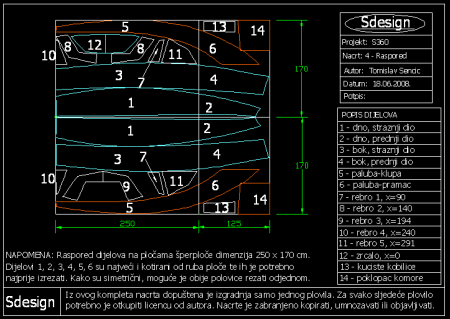
Then, for tridimensional development I use the software FreeShip. After many versions, I came with a dinghy that could be built from 3 plywood sheets (2.5 x 1.7 m).


I built a scaled down cardboard model ...


and developed a set of drawings:


The first phase of building was the building of the foils for the daggerboard and for the rudder. I glued up laths of the appropriate dimensions and used a manual planer to shape them.


Then I started to build the hull. I used a ruler and a wooden batten to transfer the drawing lines from the drawing to the plywood sheets.


I cut the parts. I glued up wooden battens along the borders of the stations in order to make them stiffer.


The bottom sides were glued together, and a stations were placed on positions.


The internal filets, the stations in place, and the side strips. It looks like a real small boat.


But there are a lot of small things to do, like protecting internal volumes with some layers of epoxy and with some paint. It is important to do it before closing the volumes. The transom also need to be stiff because it will support the rudder and because it is important for the overall torsional stability. Hence the triangular wooden elements in the corners.


After finishing the top side, the hull is turned over. The bottom looks finished, but it needs to be finished with sandpaper and protected.

A layer of thin glass fiber will be applied and impregnated with epoxy. It improves the rigidity of the bottom. It makes a composite material. Or a sandwich of plywood, epoxy resin and glass fibers.

Epoxy is not UV-radiation resistant, hence it also has to be protected by some layers of paint. A light blue does the job, plus I find it to be very nice looking.


On the top side, I left some exposed plywood surfaces, without paint. It is protected by the thin glass fiber fabric, epoxy and some layers of varnish. On some parts I made some black lines, in order to make it look like the teak strips. I made the holes for inspection hatches.


The mast is also home built. It is an aluminum-wood combination. The sail groove is a square tube with a cut. The stiffness, or the bending curve was tested, in order to get a correct sail shape.


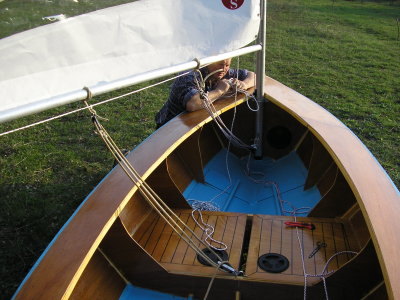
The boat is finally equipped and almost ready to sail.


I enjoyed the project and building process a lot. I had to repair some details at first. And it was far from maintenance-free, but the process was a joy. Of course, I enjoyed also lot of sailing.

Pros and cons
+ looks good
+ light weight
+ good light wind performance
+ pleasant to sail
+ simple, fast and cheap building

- there is no room for a passenger
- can't be moved by a single person or car topped
- unpractical to row
- narrow waterline, instable, not suitable for swimming or fishing trips